
You Don't Own Anything
What Happens When the Digital World Changes the Rules

Wait. I’m not talking about minimalism or spring decluttering. I’m not saying we’ll give everything up and become monks. I’m talking about how this digital era is actually stripping us of many things, even material ones, and in the long run, I’m sure we might end up missing them. I am already, and I’m taking things into my own hands because who else is supposed to do it?
Welcome to my third newsletter. Really happy to have this tiny corner of the internet to tell you my more raw thoughts. Hope you’re all having a positive experience with it. But back to my main concern.
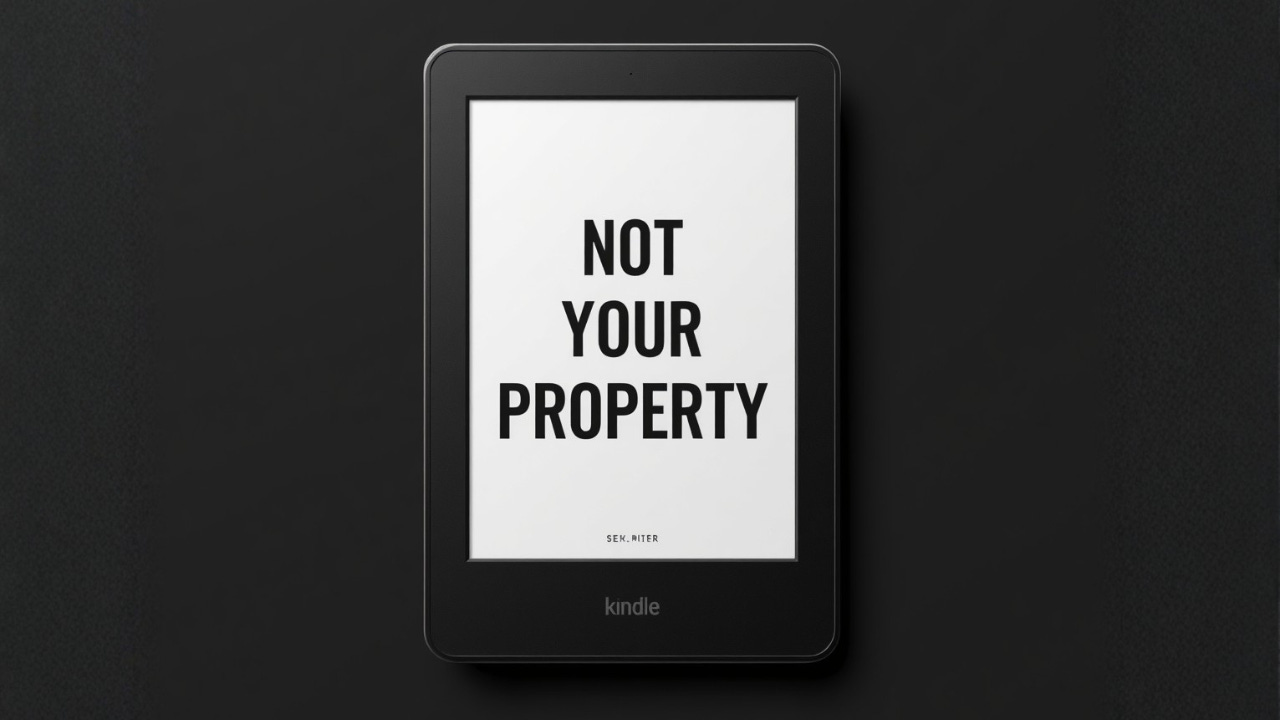
This ripping of the value of things we buy, experience, and use online is a trend I’ve been observing for quite some time now, and I’m not immune to it. It often slips into the back of my mind. It’s subtle and often goes undetected, but every once in a while, something happens, and my subconscious suddenly becomes aware of it. Like someone has shot a signal flare in a sea of darkness. You don’t know what it actually means, but you know someone is calling for help.
My signal flare yesterday was an article about Amazon ceasing updates for older Kindles. In simple words, condemning them to be useless. No more downloading, no more updating, no way to use them unless as a repository for previously downloaded items. But as you might be familiar with, when something does not get updated, it eventually crashes, and if a main reset usually helps in this case, it will not. They already warned the owners of Kindles bought before 2012 that a manufacturer’s reset will make the e-reader unusable. How nice.
In a world where pollution is a major concern above many other things, we’ll have thousands of still perfectly functioning machines thrown in the garbage.
Here’s the complete article:https://www.bbc.com/news/articles/c98k91yy4z4o
And this whole thing leads me to another consideration I made previously on my YouTube channel. We do not own anything anymore. Hundreds of books you’ve read will exist on an app but not on the ereader, nor on your shelf. You will not be able to share it or hold it in your hands. What you bought, the e-reader, will suddenly be worthless. A plastic case with a countdown kill switch turned on. A potentially useless thing, not because you dropped it or cracked it, but because Mr. Bezos, by his own volition, has decided you need to buy a new, more expensive device. He knows that people who use an ereader will still want one, and although grudgingly, many will oblige and buy a new one. A one-sided decision that he has taken from us. We’ve been ripped off of our right to choose, and on top of all of this, they will offer an even worse option, telling you it’s actually better:
A Kindle that lets you read in colour—just one step away from turning your e-reader into a tablet. But the whole point of owning an e-reader, for many of us, is to avoid the distractions of a tablet or phone. If I wanted a full-colour, backlit screen with apps and notifications, I’d just read on my iPad or phone. Instead, I choose an e-reader because it’s designed for focus, not for endless scrolling and distractions.
The technology behind a black-and-white screen helps protect our brains from becoming too distracted. We keep our focus on the page, no hyperlinks, no ads and so on. On a tablet, besides having a bigger screen than a smartphone, the experience is pretty much the same as reading on a phone. And I think it’s terrible.
And, in my opinion, this whole situation is truly worrisome. I will go deeper into how we’ve been stripped of ownership over our digital purchases in an upcoming blog post that will be out in two or three weeks, so keep your eyes on the feeds to read more of my controversial opinion on how the digital world is stripping our experiences of meaning.
That said, as a form of protest, I’ve definitely turned my phone into grayscale mode because I’m tired of being pulled and pushed by the attention economy. I have really low screen time, but I still feel the pull of shiny, bright-coloured things when I’m scrolling through news or searching the World Wide Web.
On the iPhone, it really is the easiest thing, and it makes a tangible difference. Your smartphone suddenly turns into a really boring all-gray dumbphone, but you have a shortcut whenever you need to quickly get back to colour for whatever reason. It’s a smooth and handy process.
I’ll add the link here if you want to try it out: https://www.macobserver.com/tips/how-to/how-to-grayscale-iphone/
By the way, my iPhone is a second-hand, reconditioned phone just to keep my idea of being sustainable front and center, but also to allow me to own a really smooth-working tool.
And since the human attention economy is what concerns me most…
Let’s talk books:
In a bout of nostalgia for analog life that I feel pretty strongly this year, maybe because I’m really craving grounding feelings that make me feel more in balance, I took up again a book I’ve read in 2022 and loved. The Cartographer by Peng Shepard. As a medieval historian, it’s a book that holds special fascination for me. It’s about maps and a mystery to be revealed. But it has a sense of what it feels like to work in old, history-filled places, old maps, and the rustling of paper. I loved it the first time, and I’m absolutely content in my second time reading. I’m halfway through, and it has reawakened my love for history and my university studies. almost like a walk back in time. And the suspense part is really good. Perfect for this complex life moment we are in. I needed an easy, intriguing book, and this works perfectly.
https://www.goodreads.com/book/show/55004093-the-cartographers
To reconnect with the discussion above, a very interesting read is Stolen Focus by Johann Hari.
He explores why our attention spans are shrinking in the modern world and investigates how society, technology, and the environment are conspiring to rob us of our ability to concentrate. Super enjoyable and easy to read with loads of examples of what is happening around us.
https://www.goodreads.com/book/show/57933306-stolen-focus
Let’s talk music
When the light changes, the sunsets stretch across oranges and pinks, with just a hint of haze. I suddenly search for my old Agnes Obel Philharmonics CD. Love the feeling of listening to an album from start to finish, being carried by hand in different times and places, and this one is just so fitting. A hint of melancholy, but in a sweet, gentle way. Her voice is truly captivating, and her piano parts always make me think of dark fairies singing at the edge of golden meadows shaded by big ancient trees.
https://en.wikipedia.org/wiki/Philharmonics_(album)
Let’s talk podcast
Lately, I’ve stumbled upon a deeply unsettling podcast that everyone should listen to, even if it’s hard. World of Secrets: The Darkest Web, a BBC production, pulls back the curtain on the alarming reality of online child sexual abuse—revealing just how widespread, hidden, and dangerously close to home this threat can be. The podcast exposes how abusers exploit everyday digital spaces, the immense difficulties authorities face in stopping them, and the overlooked stories of survivors. Listening was tough, but it opened my eyes to how urgent and common this issue is; we can’t afford to look away or assume it’s happening somewhere else. Child safety in the digital era demands our constant vigilance.
https://www.bbc.co.uk/programmes/w13xtvs0/episodes/downloads
Hope you will have a really nice weekend and from my forest to yours, until next time take care.
Ciao
A.
Last week I traveled from the Western US back to the East Coast to attend my father's funeral and start an overwhelming process of settling an estate that includes a farm and cattle. Dad never participated in the digital world, never touched a computer, never had a smart phone. He could do math in his head that many can only do with a calculator. What I discovered in the week that I was at the farm with my sisters,(without internet and sparse cell coverage) was peace despite the challenge that follows, a clearer head, and no desire to check a device to see what was happening in the outside world.
We have been pushed and in a sense bullied by the technological world, to comply to an agenda that is not kind to the human body or mind. Are we finally moving into a time frame where humans will push back? Will the sensitives lead the way? Thankfully, we still have choices, and as long as paper books exist, we can walk away from the madness created by Mr. Bezos and the corporate world.